
Table of Contents
ToggleIndia Budget 2026 Explained: What Every Taxpayer Should Know
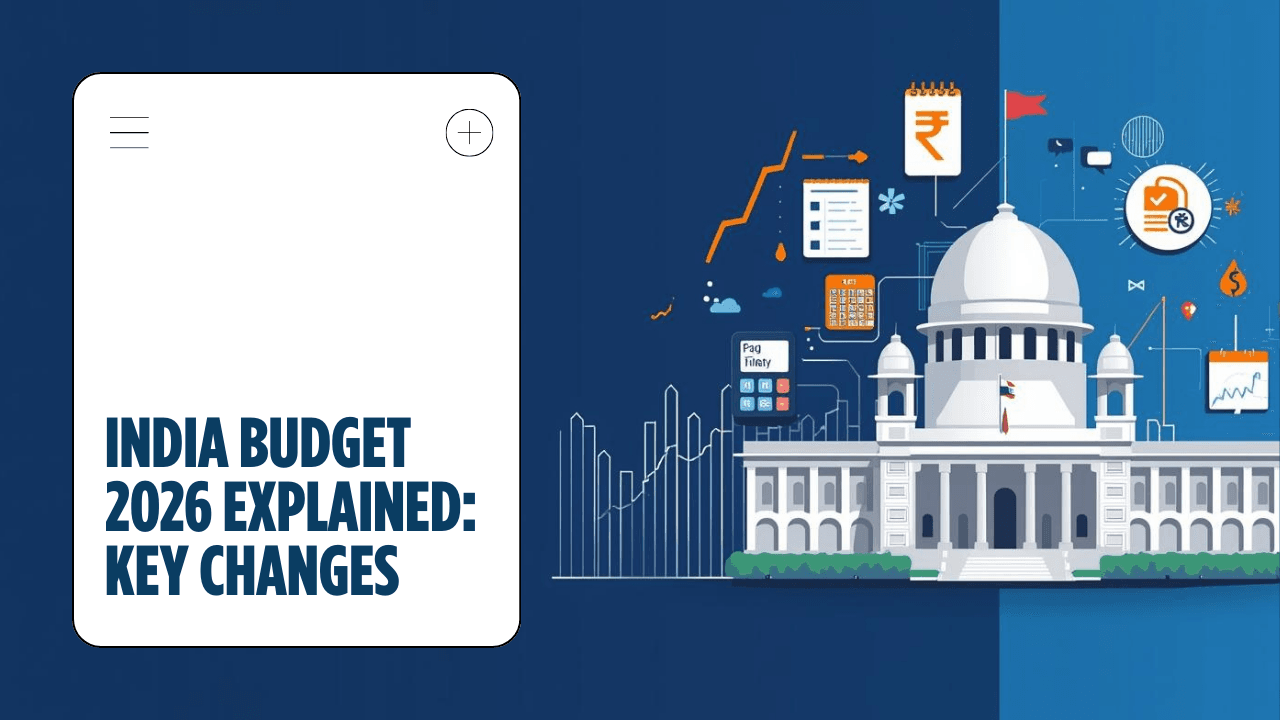
On 1st February 2026 (Sunday), the Union Finance Minister, Nirmala Sitharaman, presented the Union Budget 2026–27 in Parliament. This budget covered taxation, compliance, TDS (Tax Deducted at Source), TCS (Tax Collected at Source), STT (Securities Transaction Tax) and other important financial reforms that affect individual taxpayers, businesses, NRIs and salaried workers alike.
While income tax slab rates remain unchanged this year, the government introduced several important adjustments to tax compliance, TDS/TCS rates, deadlines, late fees, and transaction taxes that taxpayers should know.
Here’s a clear and simple breakdown of the key Budget 2026 highlights.
📌 1. Income Tax Slabs Remain Unchanged
The budget did not change income tax slab rates for individuals for FY 2026-27.
This means your basic income tax rates in both the old and new tax regimes remain the same as last year, giving taxpayers continuity and predictability.
This was reaffirmed in the Budget 2026 speech where Finance Minister emphasized stability and continued support for salaried and middle-class taxpayers. You can read parts of the official speech here:
New Tax Regime Slabs (Default, FY 2026-27)
Fewer slabs, no major deductions (only standard deduction Rs 75,000, NPS employer contribution).
| Income Range (Rs) | Tax Rate |
|---|---|
| Up to 4 lakh | Nil |
| 4 – 8 lakh | 5% |
| 8 – 12 lakh | 10% |
| 12 – 16 lakh | 15% |
| 16 – 20 lakh | 20% |
| 20 – 24 lakh | 25% |
| Above 24 lakh | 30% |
Key Relief: Effectively zero tax up to Rs 12 lakh with rebate u/s 87A (Rs 60,000).
Old Tax Regime Slabs (Opt-in, FY 2026-27)
Allows deductions like 80C, 80D, HRA (standard deduction Rs 50,000).
| Income Range (Rs) | Tax Rate |
|---|---|
| Up to 2.5 lakh | Nil |
| 2.5 – 5 lakh | 5% |
| 5 – 10 lakh | 20% |
| Above 10 lakh | 30% |
Notes: Seniors (60-80): Up to Rs 3 lakh nil; Super seniors (80+): Up to Rs 5 lakh nil. Rebate u/s 87A up to Rs 5 lakh income.
2. Revised ITR Filing Deadline
One of the most taxpayer-friendly announcements was related to Income Tax Return (ITR) filing timelines:
Taxpayers can now revise their filed ITRs up to 31st March instead of 31st December of the assessment year, giving extra time to correct errors.
However, if you file a revised return after 31st December, a nominal late fee will be applicable:
₹5,000 for most taxpayers,
₹1,000 for individuals with income not exceeding ₹5 lakh.
This extension in deadline reduces stress on taxpayers and makes it easier to correct mistakes without harsh penalties.
Due Dates Table (Updated FY 2026-27)
No changes here from prior response—extended for ease.
| Filing Type | Due Date | Late Fee |
|---|---|---|
| ITR-1/ITR-2 | Jul 31 | Standard |
| Non-audit business | Aug 31 | Rationalized (Sec 427) |
| Audit cases | Nov 30 | Rs 5,000 (>Rs 5L income) |
| Belated ITR | Dec 31 | Rs 10,000 |
| Revised ITR | Mar 31 (next FY) | Rs 1K-5K (income-based) |
Pro Tip: Choose regime based on deductions—new for low-deductions, old for investors. Verify on official sites!
💸 3. TDS (Tax Deducted at Source) Updates
Budget 2026 brought clarity and relief on several TDS fronts:
Manpower supply services are now clearly covered under TDS rules, typically at 1% or 2%, reducing confusion in compliance.
For NRIs selling property in India, TDS collection now uses PAN-based deductions rather than TAN-based, simplifying requirements.
The government also proposed an automated rule-based system for issuing “lower or nil deduction certificates” for small taxpayers, reducing paperwork and compliance hassles.
These changes aim to balance compliance with ease of doing business for employers, contractors and taxpayers alike.
🌍 4. TCS (Tax Collected at Source) Changes
TCS is collected by sellers on behalf of the government at the time of certain transactions. Budget 2026 revised some key TCS rates:
📉 Major Reductions
Overseas education & medical remittances (under LRS): 5% → 2%
Overseas tour packages: Flat 2%, down from earlier 5% / 20% slabs depending on the amount.
👉 These cuts provide direct relief for parents sending money abroad for education or treatment, and people planning international travel.
📈 Other TCS Adjustments
Some commodities like scrap, alcohol and minerals may see changes in TCS structure (usually upward), as proposed in Budget commentary.
📊 5. STT (Securities Transaction Tax) Changes
To regulate market transactions, changes were announced in Securities Transaction Tax (STT):
STT on futures trading increased from 0.02% to 0.05%.
STT on options premiums and exercise was increased to 0.15%.
These changes apply to derivatives transactions and aim to streamline market tax while maintaining investor protection.
Changes for Investors and Traders (STT and Capital Gains)
If you invest in the stock market, there was mixed news.
The “Not-So-Good” News for Traders: STT Hike The government wants to discourage excessive speculative trading in the Futures and Options (F&O) segment. To do this, they have increased the Securities Transaction Tax (STT).
STT on the sale of Futures has increased from 0.02% to 0.05%.
STT on the sale of Options has seen a steeper hike to 0.15%. If you are an active day-trader in F&O, your transaction costs just went up significantly.
The Status Quo for Long-Term Investors Many investors were hoping the government would increase the exemption limit for Long Term Capital Gains (LTCG) on stocks and equity mutual funds from the current ₹1.25 lakh to ₹2 lakh. Unfortunately, this did not happen. The exemption limit remains at ₹1.25 lakh per year. Any long-term equity gains above this are taxed at 12.5%.
📅 6. Due Dates & Late Fees – Key Calendar Changes
Budget 2026 also provided clarity on compliance timelines:
Revised ITR filing deadline extended to 31st March (with nominal fee after Dec 31).
Staggered return due dates were proposed:
ITR-1 & ITR-2 by 31st July,
Business / Trust returns by 31st August to ease rush.
Taxpayers should follow the updated calendar to avoid late filing fees, interest and notices.
🧾 7. Other Notable Tax Provisions
Beyond the headline items, Budget 2026 also announced:
Motor accident compensation interest received by individuals is now fully exempt from tax and not subject to TDS.
Interest on revised returns filed after due date may be subject to nominal penalties.
Mat credit reforms, foreign asset disclosure window and other compliance rationalizations were introduced to reduce friction.
These measures may not change your slab, but they improve fairness and practicality of the tax system.
🤔 What Didn’t Change?
Perhaps the most discussed point is: tax slab rates remain unchanged. This means:
The government chose to keep the existing income tax slabs and rates as they are.
No reduction in basic tax percentages for salaried or business income was announced in Budget 2026.
This signals a cautious fiscal strategy while focusing on simplification and compliance rather than broad rate cuts.
🔚 Conclusion: Practical Takeaways for Taxpayers
Budget 2026 may not have slashed income tax slabs, but it brought meaningful relief and clarity on:
✅ Revised ITR deadlines with relaxed filing penalties
✅ Simplified TDS and TCS rules
✅ Lower tax burdens on overseas education, medical and travel
✅ Clearer compliance guidelines and expanded deadlines
✅ STT adjustments for markets
For many taxpayers — especially salaried individuals, NRIs, students and small service providers — the emphasis this year was on ease of compliance, reduced upfront tax burden (via TCS/TDS cuts) and extended deadlines rather than universal rate cuts.
📌 Helpful Links:
🔗 Union Budget 2026 Speech & Highlights https://www.indiabudget.gov.in/doc/bspeech/bs2025_26.pdf
#Budget2026 #UnionBudget #IncomeTax2026 #TDSChanges #TCSReduction #ITRDeadline #STTRates #TaxPlanningIndia